Maya kept a pencil behind her ear because maps could appear at any time.
Sometimes they appeared as a proper question from her teacher, such as: Can you draw the quickest route from the library to the museum? Sometimes they appeared as a thought while walking home: Would the cat take the pavement or the garden wall? Maya liked both kinds.
On the evening of the school lantern walk, she sat at the kitchen table drawing a map of the park. There would be a group of children, a line of grown-ups, and one small path through the trees to the old bandstand. Her mum had said it was an easy route.
Maya still drew every turn.
At the bottom of the page, a tiny metal hand tapped twice.
"You have forgotten the bench," said Piko.
Piko was no taller than a thermos flask. He had round brass eyes, rubber wheels and a useful pocket for paper clips. Maya had built him from a kit with her grandad, although Piko claimed he had improved himself since then.
"The bench is not part of the route," Maya said.
"It is part of the park," said Piko. "Good maps know the difference."
Maya added the bench.
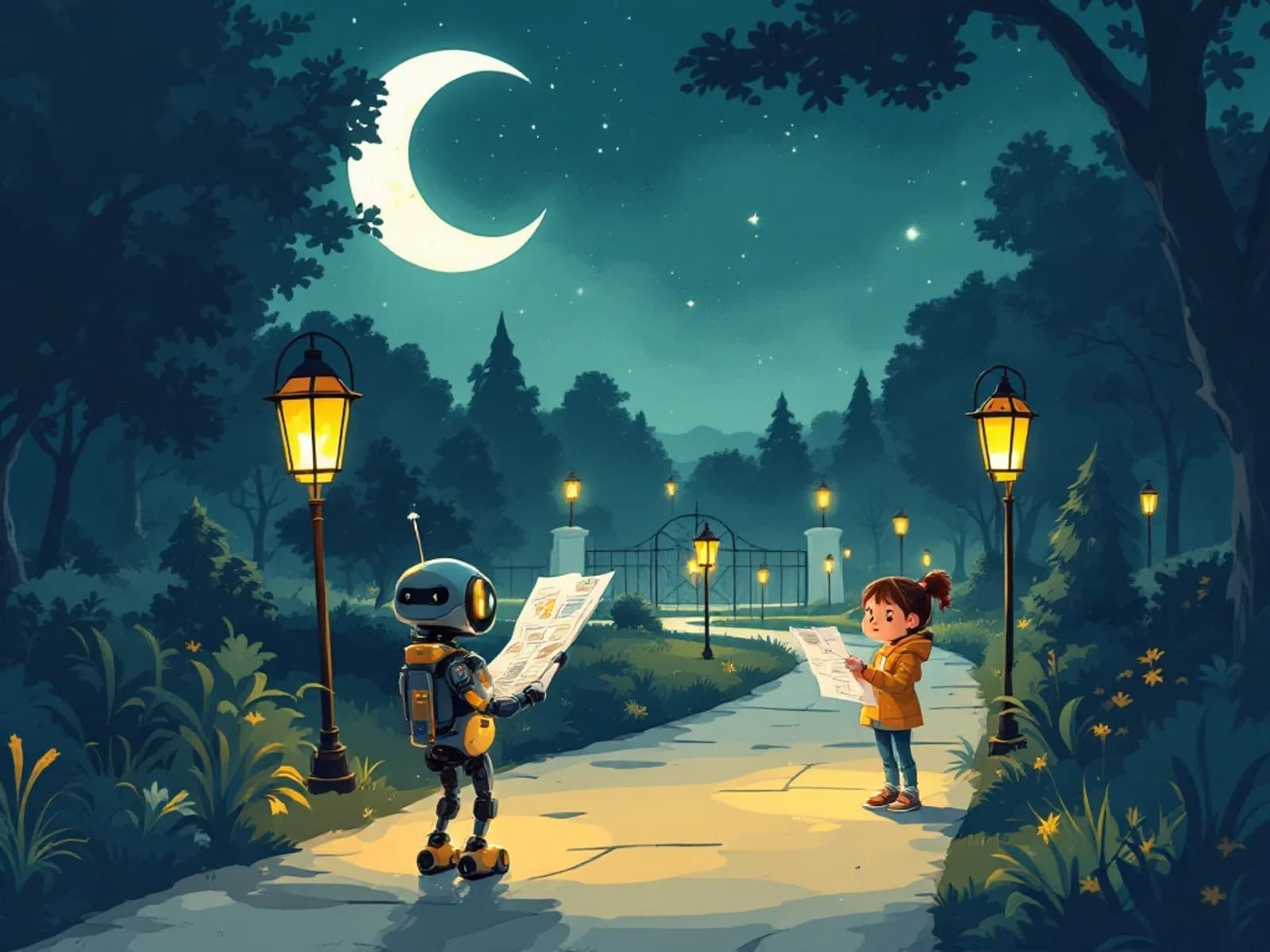
By the time they arrived at the park, the sky was dark blue. The grown-ups had lanterns, and the children carried little paper lights on sticks. Along the path, the trees looked like tall black shapes with silver edges.
Maya had her map folded in her coat pocket. Piko rode in the other pocket, his little antenna peeping out.
The lantern walk began. Everyone followed the path past the pond, over the small bridge and towards the bandstand. Maya checked her map as they went.
Pond. Tick.
Bridge. Tick.
Then a gust of wind hurried through the trees.
One lantern went out. Then another. A few children stopped walking.
"The lights are fine," said one of the grown-ups. "Stay together."
But when Maya looked up, the group had taken a different path around a fallen branch. It was only a short detour, yet her map did not show it. The familiar path was hidden behind the trees.
"We can wait for the grown-ups," Piko whispered.
Maya listened. She could hear voices ahead, but they were soft and mixed with the wind. Her first thought was to follow them quickly. Her second thought was better.
"No running," she said. "We need to know where we are."
Piko's brass eyes warmed to a small amber glow. "A map-maker speaking sensibly."
Maya unfolded her paper under the light of a lantern. She knew they were somewhere between the bridge and the bandstand. But where?
"Look for things the map can use," said Piko.
Maya looked around. To her left was a low stone wall. Ahead was a gate with a star-shaped hole in it. On the right, a row of small solar lights glowed beside the ground.
"The wall is not on my map," Maya said.
"Then your map is not finished," said Piko.
Maya did not like that at first. She had spent a whole hour making it neat. But she took out her pencil.
Stone wall. Star gate. Small lights.
As soon as she had written the words, she felt calmer. The park was no longer a place where the route had gone wrong. It was a place with new details.
One of the younger children was standing nearby, holding an unlit lantern. "Are we lost?" he asked.
Maya shook her head. "Not exactly. We are finding a new part of the map."
The child considered this. "Can I help?"
"Yes," Maya said. "Can you count the small lights?"
There were seven. At the seventh light, the path turned gently beside a hedge. Maya heard the bandstand bell ring once in the distance. Not loudly. Just enough.
"That way," she said.
They walked slowly to the bend, keeping together. At the other side, the voices became clear. The group was gathered by the bandstand, where the lanterns were being relit one by one.
Maya's mum saw her and smiled. "There you are. We took the side path."
"I know," Maya said. "It has a stone wall, a star gate and seven small lights."
Piko made a pleased clicking noise from her pocket.
At home, Maya spread the map on her desk. She added the new path in a dotted line. Beside it, she drew seven tiny stars.
At the top she wrote: THE MAP OF SMALL LIGHTS.
Piko parked beside the paper. "You did not make a wrong map," he said. "You made a first map."
Maya thought that was a very good difference.
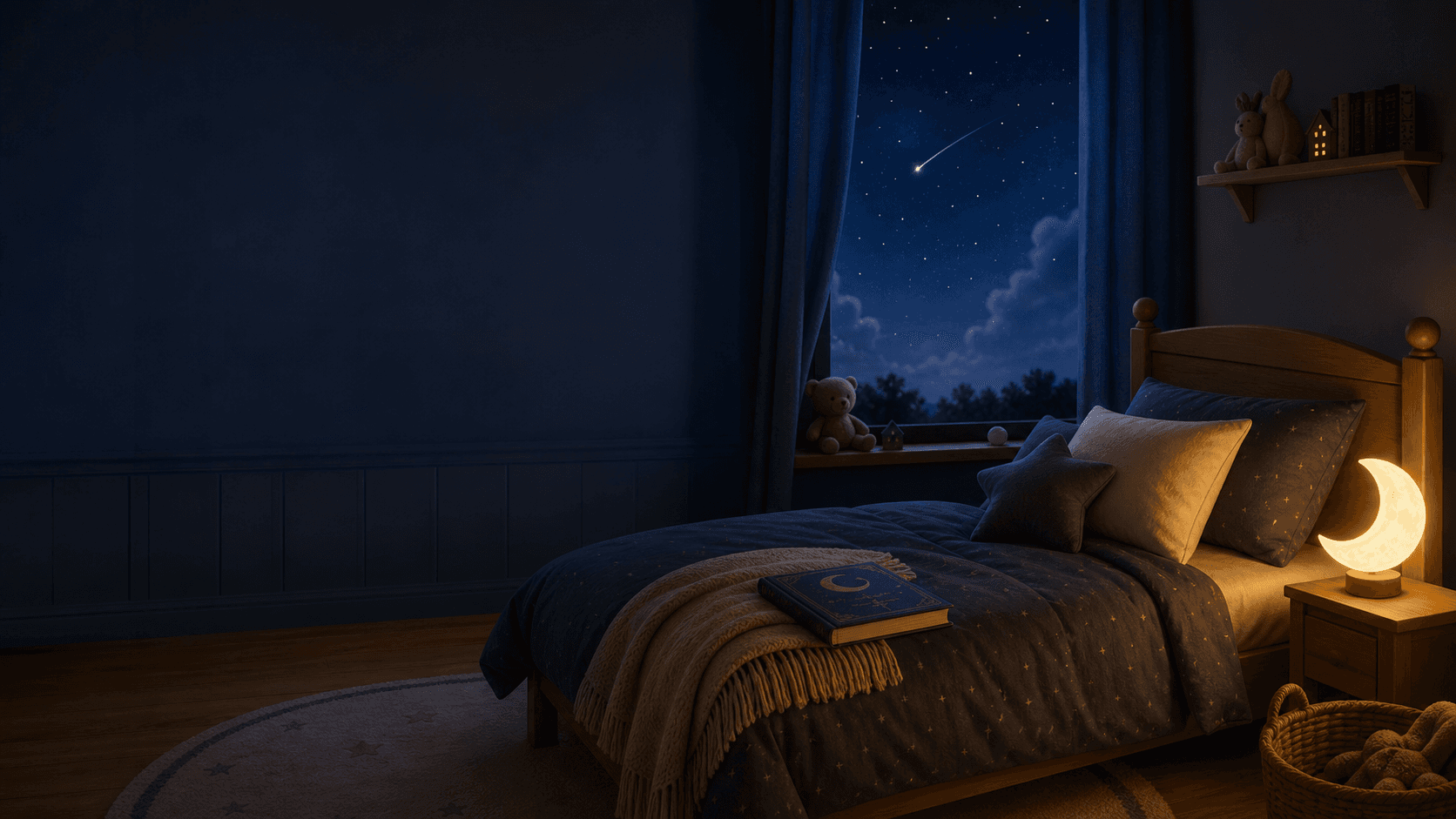
She put the pencil back behind her ear, turned off the desk lamp and climbed into bed. Outside, the night held many small lights of its own. Maya did not need to count them all. It was enough to know they were there.